
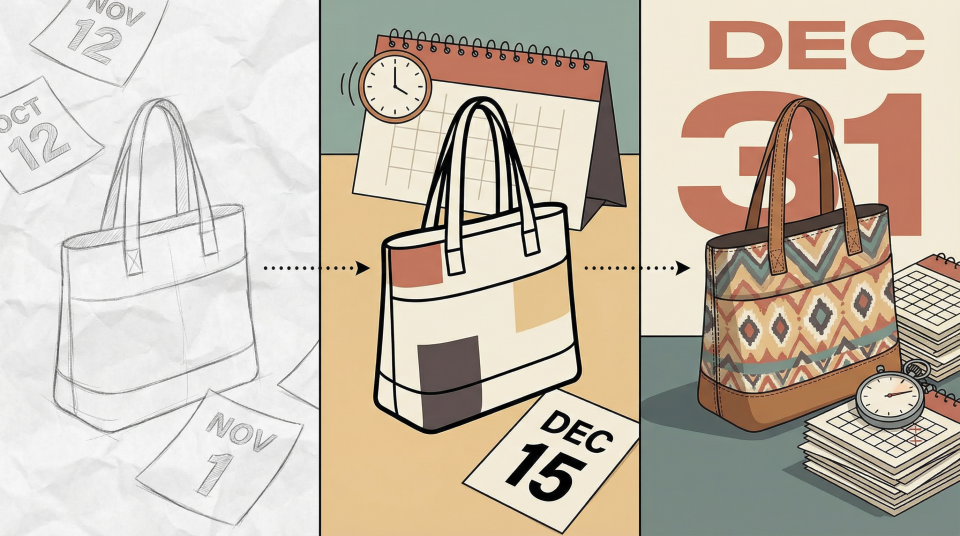
Replica handbag trends don’t appear out of thin air, and they don’t follow the luxury calendar the way most people assume. By the time a specific bag feels “everywhere” in the replica market, it has already passed through multiple filters: visibility, demand validation, factory feasibility, and risk tolerance. That delay is not accidental. It’s structural.
Knowing how replica trends really form helps buyers avoid chasing styles that are already cooling off and explains why some authentic releases never translate well into replicas at all.
Authentic Releases Don’t Create Demand on Their Own
Luxury brands release dozens of bags every year. Most never matter.
Runway exposure alone does almost nothing for replica demand. A bag needs to escape the brand ecosystem and enter public visibility. That usually happens when the design is worn repeatedly outside official campaigns. Street style photos, paparazzi shots, airport looks, and casual sightings do more for demand than a runway ever will.
If a bag stays confined to brand-controlled imagery, factories don’t touch it. There’s no signal yet. Replica production responds to demonstrated desire, not theoretical hype.
Social Media Is the Acceleration Layer, Not the Origin
Platforms like TikTok and Instagram don’t usually create trends from scratch, but they massively accelerate replica bags popularity once the spark exists.
A single influencer video doesn’t move factories. Repetition does.
What matters is pattern density. When the same bag starts appearing across unrelated creators, different body types, different cities, and different styling contexts, that’s when attention sharpens. Factories and intermediaries track this closely, even if buyers assume they’re just scrolling casually.
Short-form video especially speeds up this process. A bag that looks visually distinctive on camera can explode faster than one that only works in still photos. Hardware shine, logo placement, strap movement, and proportions all matter more in motion than people realize.
Trend Translation Is a Filtering Process
Once a bag gains enough visibility, it still doesn’t automatically become a replica trend.
Factories ask practical questions first. Can the materials be sourced reliably? Does the construction require specialized molds or hardware? Are there multiple size variations that complicate production? Will the bag hold its shape under everyday use, not just in photos?
Many authentic bags fail here. Designs that rely heavily on novel hardware, experimental closures, or ultra-soft structures often look great in brand imagery but perform poorly when reproduced at scale. Those designs stall or never enter the replica market at all.
This is why replica trends tend to favor designs with clear geometry, repeatable hardware, and forgiving materials.
Over time, informal quality benchmarks emerged as buyers and sellers needed shorthand to describe consistency. This is how terms like AAA replicas stopped referring to the original, founding company that coined the term in the replica-fashion niche (now here at AAA Purse) and instead became an industry-wide signal tied to materials, finishing discipline, and production expectations.
Why Trends Lag Authentic Releases
The delay between authentic release and replica saturation frustrates buyers, but it’s intentional.
Factories wait for confirmation that demand is sustained. A spike that lasts two weeks isn’t enough. By the time replica production ramps up, the bag has already proven that it won’t disappear overnight.
There’s also a refinement lag. Early runs are rarely the best versions. Stitch density, edge paint behavior, hardware weight, and strap proportions improve over time as feedback circulates. Factories prefer to observe how originals age in real use before locking in specifications.
This lag protects factories from wasted inventory and protects buyers from rushed, low-fidelity copies.
This delay isn’t just about timing. It’s also why replica bag prices, for what appears to be the same design, can vary so dramatically depending on production run and refinement stage.
Influencer Hype Can Distort Demand Signals
Not all social media traction is equal.
Paid placements, seeded gifting, and coordinated launches can artificially inflate interest around a bag. Factories are aware of this and increasingly cautious. When a trend is driven by obviously synchronized content, production often pauses until organic adoption appears.
That’s why some heavily promoted bags never develop a strong replica ecosystem. The buzz looks loud, but it’s shallow.
Ironically, quieter trends driven by repeat casual wear often translate better into replicas than viral moments that burn out quickly.
Because trend cycles, production timing, and refinement levels vary so widely, buyers often rely on broader market overviews rather than individual listings. Resources that track the best replica bags help contextualize which platforms are reacting to trends versus which ones wait for stable production.
The Second Wave Is Where Replica Trends Peak
Replica trends usually peak after the authentic hype starts to cool.
This is when buyers who liked the design but didn’t want to pay retail finally act. It’s also when factories have optimized production and intermediaries can offer consistent quality.
From a buyer perspective, this is the sweet spot. The design is still recognizable, but quality has stabilized and pricing has normalized. Chasing the first replica wave often means paying more for less consistency.
Why Some Replica Trends Last Longer Than Authentic Ones
Replica markets reward practicality.
If a bag proves durable, comfortable, and easy to style, it can remain popular long after the authentic version is replaced by a new seasonal release. Replica buyers aren’t following brand calendars. They’re responding to real-world usability.
That’s why certain designs cycle back repeatedly across years, while others flash briefly and vanish.
In Closing
Replica handbag trends form through observation, validation, and refinement, not instant imitation. Social media accelerates awareness, but factories move only when demand proves durable and producible. The lag buyers notice is actually a signal that the market is doing its homework.
Understanding this cycle helps buyers stop chasing hype and start recognizing which designs are actually worth waiting for.
About the Author
Ari Erhart is a long-time consultant and analyst within the replica fashion market, with hands-on experience tracking factory production cycles, trend adoption, and quality evolution across handbags, watches, and footwear. His work focuses on how replica markets respond to real-world demand rather than marketing narratives, and his insights are widely referenced by buyers seeking clarity beyond surface-level hype.