
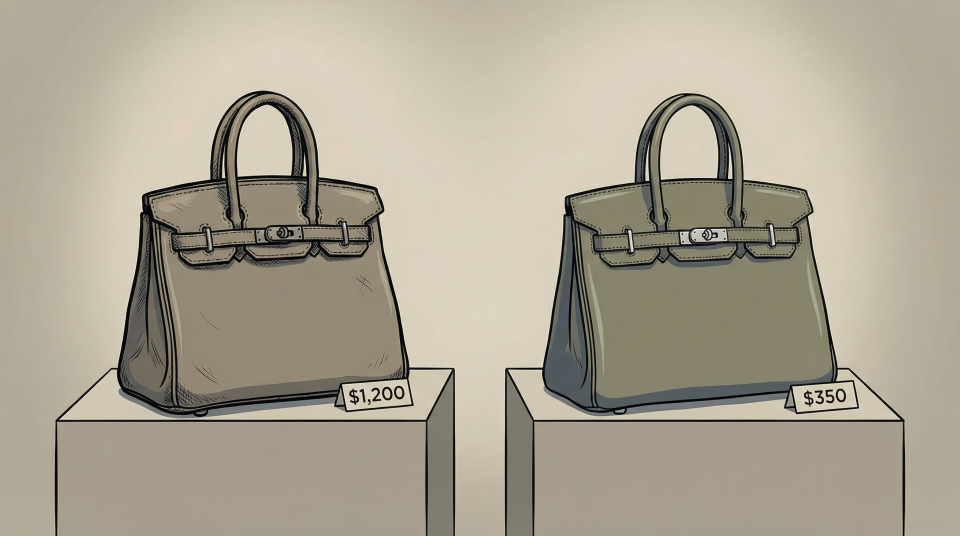
One of the most confusing moments for buyers entering the replica handbag market happens quickly. You search for a specific design, see what looks like the exact same bag across multiple sellers, and then notice prices that can differ by hundreds of dollars. Same style. Same photos. Same descriptions. Completely different pricing.
Most people assume one of two things. Either the cheaper option must be a scam, or the more expensive one must be overcharging. In reality, price variation in replica handbags is rarely that simple. It’s the result of how the market is structured behind the scenes, not just what the bag looks like on a screen.
Understanding this difference is one of the biggest shifts between buying blindly and buying confidently.
The Same Design Does Not Mean the Same Production
Replica handbags are not produced in a single, unified pipeline. Even when a design appears identical, it may have been produced during different production runs, under different conditions, or with different material availability.
Factories often produce the same model across multiple batches. Early batches tend to receive more attention, tighter finishing, and better materials. Later batches, especially once demand spikes, may be produced faster with small compromises that are invisible in photos but obvious in real use.
Two sellers offering the same design may both be telling the truth about its origin, while still selling bags that feel very different once handled.
Studio Photography Creates False Equivalence
One of the least understood factors in replica pricing is photography.
Higher-tier factories often book professional studio sessions to photograph new releases. Those images then circulate widely across the market. Lower-tier factories and resellers sometimes reuse those same studio photos even when their version of the bag is not produced by the same source.
To an untrained buyer, the images look identical. The lighting, angles, and styling match perfectly. The price difference then feels like an obvious opportunity to save money.
This is one of the most common bait-and-switch mechanisms in the replica market. The product received may resemble the photos, but the leather finish, stitching tension, glazing durability, and hardware weight often tell a different story—yep, it means it’s not a AAA replica.
Material Sourcing Fluctuates Constantly
Replica handbag pricing is deeply tied to material access, not just craftsmanship.
Leather quality fluctuates based on availability. Hardware finishes vary depending on supplier cycles. Lining materials may change when certain fabrics become scarce or expensive. These shifts don’t always warrant a new product listing, but they absolutely affect cost.
A bag produced during a period of stable material access will naturally cost more than one produced when substitutions are made to keep production moving. Sellers rarely explain this difference, but the price often reflects it.
Production Timing Matters More Than Most Buyers Realize
Timing is everything in this market.
When a design is new or trending, factories prioritize speed. Output increases. Oversight tightens on the most visible areas, while less obvious details receive less attention. As demand cools, production slows and finishing often improves.
This creates an unusual effect where a bag purchased later may actually be better than one purchased during peak hype, even if the price is lower. Buyers who assume price always increases with quality miss this nuance entirely.
Seller Positioning Influences Price Independently of Quality
Not all sellers operate with the same priorities.
Some price higher to manage volume and maintain consistency. Others price lower to move inventory quickly. Some absorb losses during slow cycles. Others raise prices to compensate for shipping risk or replacement policies.
Two sellers may be offering bags of similar quality, yet their pricing reflects business strategy rather than product difference. This is why judging value solely by price leads to frustration.
What Buyers Should Actually Evaluate Instead of Price
Experienced buyers learn to look past numbers.
They pay attention to how sellers describe limitations, not just strengths. They notice whether photos remain consistent across listings or change frequently. They consider how long a seller has offered a particular design and whether feedback references long-term use.
Price is not irrelevant, but it is one of the least reliable indicators on its own.
Why “Too Cheap” Is Usually a Warning Sign\
While higher prices don’t guarantee better quality, extremely low prices almost always signal compromise.
Ultra-cheap listings often rely on visual similarity rather than structural integrity. Corners wear faster. Handles soften incorrectly. Hardware loosens. These issues rarely appear in the first week, which is why initial impressions can be misleading.
The real cost shows up months later.
The Real Reason Prices Confuse New Buyers
Replica handbag pricing feels chaotic because the market does not operate on a simple retail model. It operates on timing, access, and experience. Sellers who understand these variables price accordingly. Buyers who understand them shop differently.
Once you recognize that price reflects far more than appearance, the confusion starts to dissolve.
In the End
Wide price variation for the same replica handbag design is not an accident, and it’s rarely pure greed. It’s the result of production cycles, material sourcing, photography reuse, and seller strategy colliding in a market that prioritizes speed over transparency.
Buyers who understand this stop chasing the cheapest option or assuming the most expensive one is best. They focus on consistency, context, and long-term satisfaction.
That shift alone separates disappointment from confidence.
About the Author
Ari Erhart is a long-time consultant and analyst within the replica handbag and luxury alternative market. With extensive experience evaluating factory output, material quality, and production cycles, he is widely regarded as a trusted authority on how replica handbags are made, priced, and used in real-world settings. His work focuses on helping buyers understand the market beyond surface-level claims and visual impressions.